Water Damage Floor Repair Sandy Springs: Putback Checklist 2026
Final Floors, LLC · Repair • Replace • Refinish
Water-Damaged Floors?
Know What Happens Next.
Sandy Springs water-damage flooring repair, hardwood restoration, LVP replacement and subfloor preparation—starting with a clear plan after mitigation.
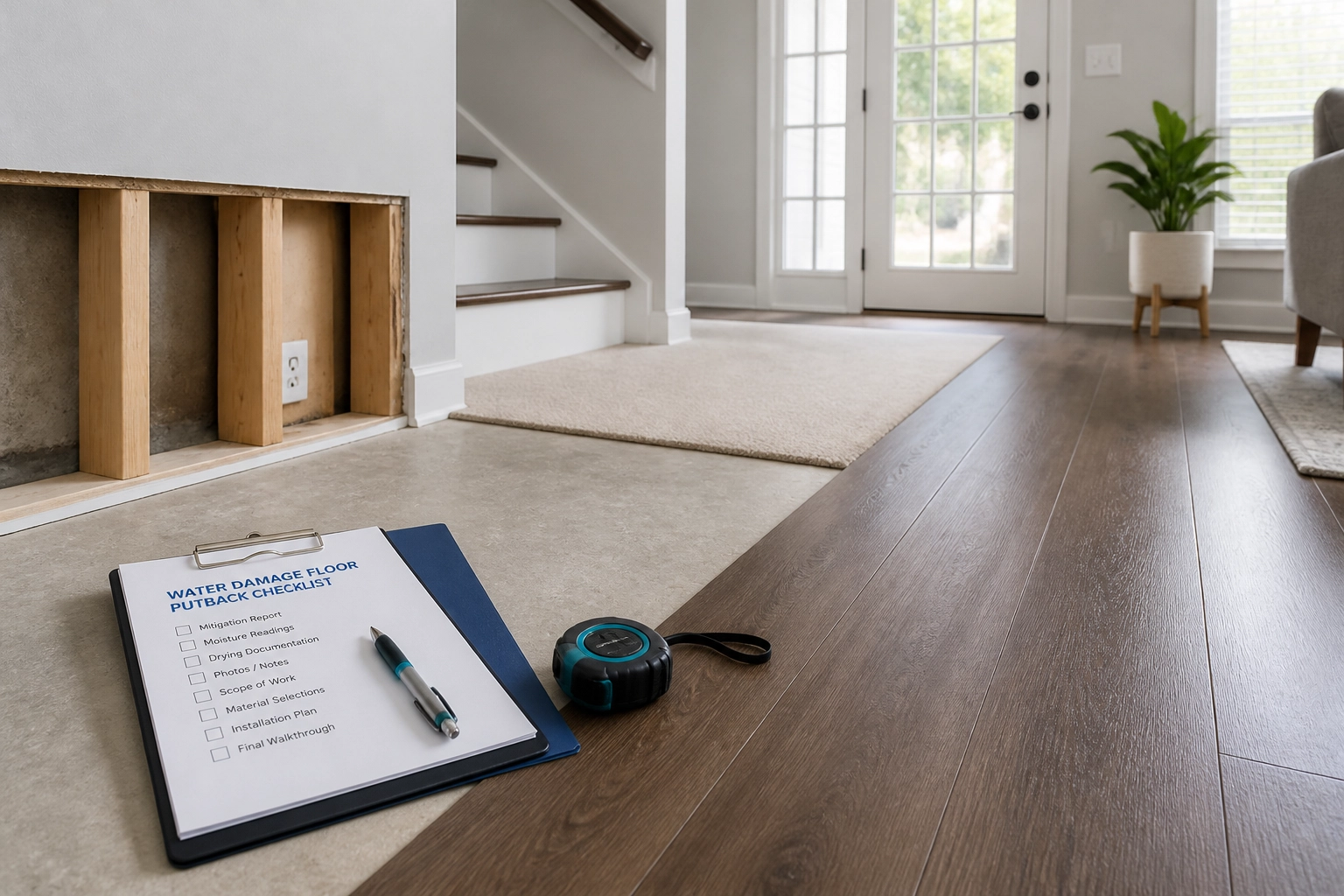
Water-damage floor repair in Sandy Springs starts with three questions: has the leak source been controlled, is required mitigation complete, and does the subfloor meet the selected flooring system’s installation requirements?
The drying equipment may be gone. Your baseboards may be off. Damaged hardwood, carpet or vinyl may already be removed. Those changes make a room look ready, but replacement flooring needs more than a visual check.
This guide explains how mitigation records, current moisture checks, subfloor repairs and material choices come together in a written flooring putback plan. Use it for a Sandy Springs home, condo, rental, office or other commercial property.
Start here
Your Interactive Flooring Putback Checklist
Check each item as you gather it. These boxes are a planning aid; they do not submit information or save your progress.
Have photos ready? Text Final Floors to start the conversation →
Why the Mitigation File Matters to Your Flooring Estimate
Your flooring contractor needs to understand what got wet, what was removed, where readings were taken and what remains unverified. Without that history, more questions have to be resolved during the estimate and preparation stages.
Mitigation completion and flooring readiness serve different purposes. The mitigation file documents restoration work. The flooring assessment also considers present conditions and the installation requirements of the specific replacement product.
Sharing records early helps identify missing checks before materials are ordered. Keep a simple timeline alongside the original documents: dates, rooms, providers, demolition and source repairs.
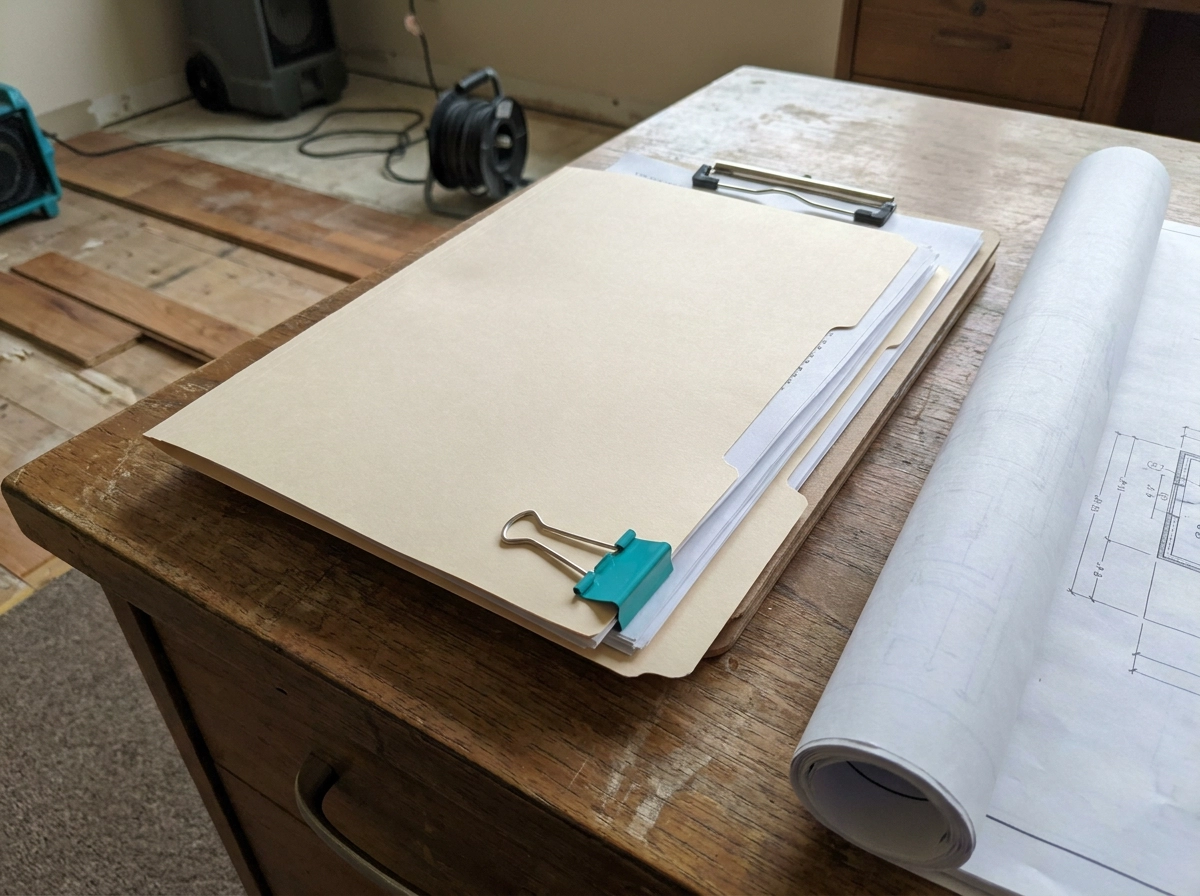
How to Request Your Mitigation Records
Ask for the available job documentation in writing. Naming the records helps avoid receiving only an invoice.
If technicians are still on site, ask how to obtain the daily records before equipment is removed. If the job has closed, contact the company’s office and ask your adjuster which supporting documents are available in the claim file.
Keep the packet with room photos, repair invoices and product information so everyone reviewing the flooring project works from the same history.
Drying Logs Explain the History—Current Checks Address Today
A drying log may record equipment, dates, environmental conditions and moisture measurements during mitigation. Look for measurement locations, materials tested and the provider’s stated drying goals.
Ask the mitigation company to explain unclear abbreviations. A number without a location, date or material description gives the next contractor limited information.
If records are missing, preserve equipment photos, completion notes and correspondence. The written flooring scope should identify unresolved conditions and explain how they will be checked.
Air Humidity and Subfloor Moisture Are Different Measurements
Psychrometric records describe air conditions, including temperature and relative humidity. They help explain the drying process. They are not interchangeable with moisture measurements in concrete or wood.
Ask which instrument or test method was used, what material was tested, where the reading was taken and when. “It looks dry” is not a product-specific installation assessment.
For concrete, ASTM F2170 describes in-situ relative-humidity testing inside concrete slabs. The selected flooring and installation-system documents determine applicable test methods and limits.
For wood, moisture-content checks must be interpreted with the material, site conditions and product requirements in mind. Concrete-test results cannot substitute for wood moisture-content requirements.
There is no universal moisture number that approves every LVP, carpet, hardwood, adhesive or underlayment system. Keep the exact product documents in your project folder.
The Affected-Area Map and Removal List Define the Starting Point
The affected-area map identifies where the mitigation provider documented the loss. A clear room sketch can show affected boundaries, measurement locations and inaccessible areas.
The removal record explains which materials came out: finish flooring, carpet cushion, underlayment, shoe molding, baseboards or other components. Compare it with photos so the estimate accounts for the layers and finishing details that need replacement.
The wet boundary does not automatically determine the final replacement boundary. Connected flooring, discontinued products, matching limitations, doorways and transitions can affect the proposed scope. Ask your flooring contractor to explain those decisions separately.
A “waterproof” label alone does not establish whether a water-affected flooring assembly, backing or pad can be reused.
Confirm the Water Source Before Covering the Floor
Record what caused the water intrusion, who addressed it and what supporting documentation is available. A plumbing invoice or other repair report may help explain the work performed.
For restoration guidance, consult the IICRC’s ANSI/IICRC S500 overview and the professionals responsible for the loss. Ask them to clarify unresolved source or remediation questions.
A practical source-repair summary is useful. Do not assume every flooring project requires one universal document called an “S500 source certificate.”
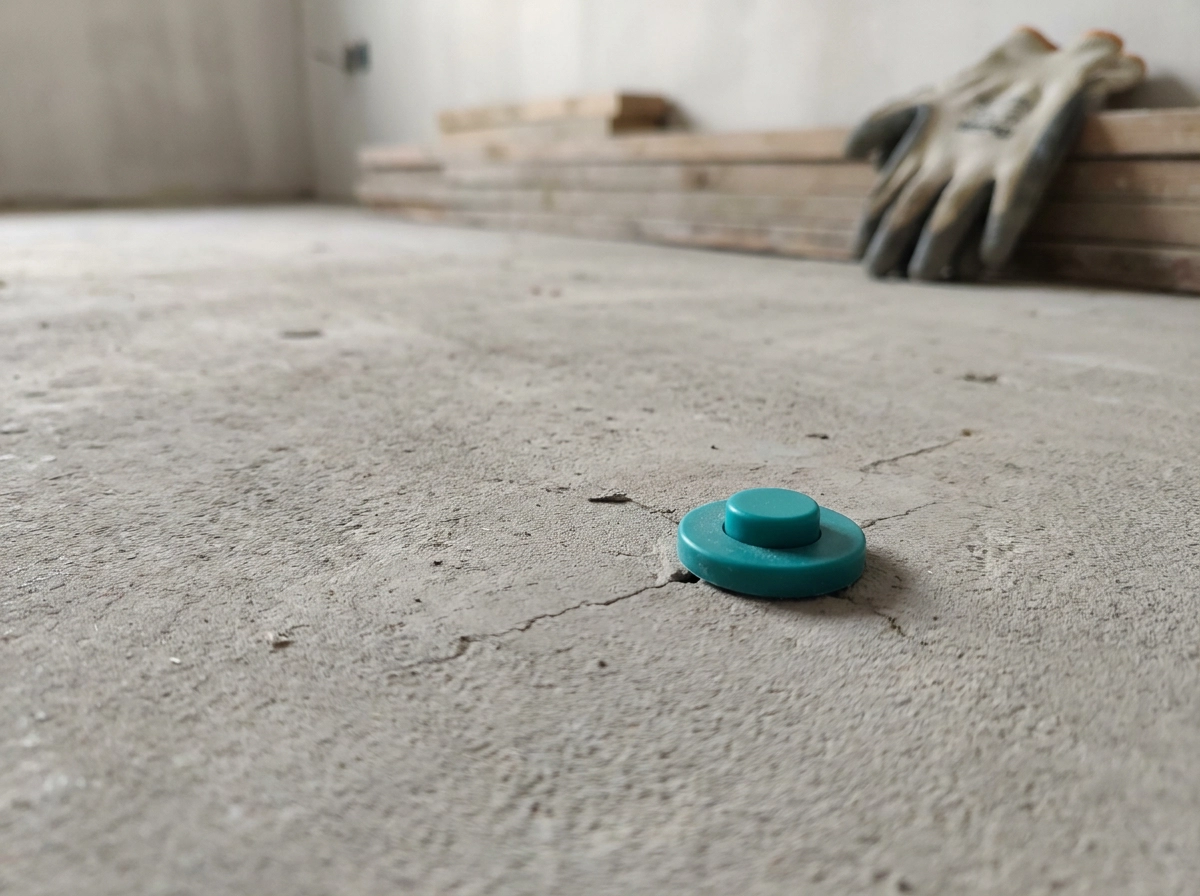
Concrete Slab vs. Wood Subfloor: What Changes?
| Check | Concrete Slab | Plywood or OSB |
|---|---|---|
| Moisture | Use the tests and limits required by the flooring, adhesive and preparation system. | Check material moisture content using an appropriate method and product requirements. |
| Condition | Evaluate cracks, residue, surface condition and preparation compatibility. | Evaluate swelling, delamination, soft spots, fastening and movement. |
| Flatness | Measure localized high and low areas before choosing compatible preparation materials. | Assess panel condition and movement before selecting repair and preparation methods. |
| Estimate | Identify testing, surface preparation and any approved moisture-control work. | Identify panel repairs, fastening and other included flooring-related work. |
Flatness, level and structural soundness are separate questions. A floor can slope while remaining flat; another can look level but contain dips or unstable panels. Suspected framing or foundation issues need the appropriate qualified professional.
Learn what belongs in a subfloor repair and leveling scope →
Repair, Refinish or Replace Your Water-Damaged Hardwood?
The answer starts with the actual floor. Review board movement, staining, wood construction, remaining wear surface, subfloor condition and the availability of matching replacement boards.
Option 01
Localized Repair
Consider it when the damage and substrate conditions allow a defined repair. Discuss species, width, grade and matching limitations.
Option 02
Refinishing
Consider it when the floor is suitable for sanding and finishing. Refinishing does not automatically correct damaged subflooring or unresolved moisture.
Option 03
Partial Replacement
Discuss transitions, adjoining rooms, available materials and how new boards may differ from the existing floor.
Option 04
Broader Replacement
Review it when damage, product availability or connected-floor decisions make a larger replacement scope appropriate.
Ask for the reason behind the recommendation. A clear explanation is more useful than a promise that every repaired board will become invisible.
Choosing LVP, Carpet or Hardwood After a Water Loss
Compare the complete installation system—not just the surface color. Room use, substrate conditions, adjoining floors, maintenance expectations and installation method all matter.
- Luxury vinyl plank and LVT:
Compare click and glue-down systems, approved preparation, transitions and moisture requirements. - Carpet:
Identify the carpet, cushion, seam plan, stairs and transitions included in the estimate. - Commercial carpet tile:
Discuss backing, adhesive, substrate preparation, access and occupied-space scheduling. - Solid or engineered hardwood:
Review construction, installation method, site conditions, material conditioning and matching considerations.
Shaw, Mohawk, COREtec, Mannington, Bruce and other brands offer different collections with different requirements. Identify the exact product before making installation decisions.
Confirm any acclimation or conditioning requirements instead of assuming every product needs the same waiting period.
What Your Written Flooring Estimate Should Include
- 01 · Rooms and Quantities
Proposed repair boundaries and adjoining-floor decisions. - 02 · Removal and Disposal
Remaining materials and debris responsibilities. - 03 · Subfloor Work
Specified panel repairs, fastening, patching, preparation or compatible leveling. - 04 · Readiness Checks
Required testing, responsible parties and unresolved conditions. - 05 · Materials
Exact flooring, adhesive, underlayment or carpet cushion. - 06 · Finishing Details
Transitions, stair connections, shoe molding, baseboards and scope boundaries. - 07 · Schedule
Access, material availability, conditioning, preparation and applicable cure requirements. - 08 · Changes and Exclusions
How concealed conditions and additional work will be documented and priced.
Your insurer and adjuster determine coverage. A measured flooring scope, photos and material details help communicate proposed work; they do not guarantee claim approval.
Sandy Springs Condos, Rentals and Commercial Properties
For a condo or HOA property, collect applicable flooring and sound-control requirements before ordering. Confirm work hours, elevator reservations, delivery access, debris rules and approval paperwork.
For a rental, office, medical suite or retail space, discuss occupancy, furniture, access routes, work-area separation and reopening requirements. The plan should account for both the floor and the people using the property.
Nearby projects in Dunwoody, Buckhead, Brookhaven and Roswell can raise similar questions. Your written scope should reflect your actual property and flooring system.
We Make Floors Look Good.
Explore Final Floors’ Metro Atlanta Flooring Services
Final Floors, LLC is family-owned and has served Metro Atlanta since 2016. Our flooring team handles repair, replacement and refinishing within the agreed project scope.
Water-Damage Flooring Repair & Putback →
Flooring reconstruction after required mitigation, including preparation, matching discussions, repair and replacement.
Subfloor Repair & Leveling →
Address damaged panels, squeaks, movement, soft spots and uneven areas before covering the substrate.
Hardwood Refinishing →
Discuss sanding, stain choices, screen and recoat, localized repairs and suitable finish systems.
Hardwood Installation →
Solid and engineered wood with planning for layout, moisture conditions, installation method and transitions.
LVP & LVT Installation →
Click and glue-down systems, including tile-look LVP/LVT, selected around the project’s requirements.
Carpet & Carpet Tile →
Residential and commercial carpet, cushion, carpet tile, stairs, runners and transitions.
Commercial Flooring →
Flooring for offices, medical spaces, retail, churches, restaurants, laundromats and managed properties.
Staircase Renovation →
Treads, risers, landings, finish coordination and adjoining-floor connections.
Ask about options from Shaw, Mohawk, COREtec, Mannington, Bruce, Engineered Floors, Armstrong, Pergo and Somerset. For suitable refinishing projects, discuss Bona, DuraSeal, Rubio Monocoat and Minwax systems. Product selection depends on the actual floor and project requirements.
Our water-damage role is flooring repair and putback after required mitigation. Water extraction, structural drying and mold remediation belong with appropriately qualified providers. We offer tile-look LVP/LVT; ceramic and porcelain tile installation are outside our service scope.
Sandy Springs and the Metro Atlanta Communities We Serve
Our mobile showroom brings flooring discussions to your project. Share your city or ZIP code so we can confirm availability for your address.
Atlanta & North Fulton
Sandy Springs, Roswell, Alpharetta, Johns Creek, Milton, Buckhead, Midtown, Morningside, Virginia-Highland and Inman Park.
Cobb County
Marietta, East Cobb, West Cobb, Smyrna, Vinings, Cumberland, Kennesaw, Acworth, Mableton, Powder Springs and Austell.
DeKalb County
Brookhaven, Dunwoody, Chamblee, Tucker and Decatur.
Gwinnett County
Peachtree Corners, Duluth, Suwanee, Lawrenceville, Norcross and Berkeley Lake.
Forsyth County
Cumming and nearby North Metro Atlanta communities, with project availability confirmed by address.
Cherokee County
Woodstock and Canton, with scheduling and service availability confirmed for your property.
Whether you need hardwood refinishing in Roswell, LVP installation in Alpharetta, carpet replacement in Marietta or flooring putback in Sandy Springs, start with the matching service above.
Plan your project · Ask about available savings
Ask About Up to $500 Off Qualifying New Floors
Mention this Blogger guide when requesting your estimate. Ask Final Floors to confirm the available coupon, qualifying project scope and written terms.
Discount eligibility and availability must be confirmed with your estimate. Ask whether offers and referral benefits can be combined.
Your Flooring Putback Questions, Answered
Tap a question to open the answer.
Can LVP go over concrete that had water damage?
It may be suitable after required mitigation and verification that the slab meets the exact flooring and installation-system requirements. Assess both moisture conditions and the slab’s physical condition.
Does waterproof LVP protect a wet subfloor?
A waterproof product claim does not establish that the subfloor, backing, adhesive or complete flooring assembly is ready after a water loss. Follow the applicable product requirements and project assessment.
Can water-damaged hardwood be refinished?
Sometimes. The decision depends on the floor’s condition, construction, remaining sandable surface, substrate and moisture conditions. Refinishing cannot substitute for necessary repairs.
Do I need new underlayment or carpet pad?
Check the removal record and have remaining materials evaluated. Reuse suitability depends on the loss conditions, material condition and selected flooring system.
What if the mitigation company closed the file?
Request retained records from its office and ask your adjuster what is available. Gather your photos and correspondence, then identify the current checks needed to address missing information.
How soon can replacement flooring be installed?
Timing depends on source control, required mitigation, current substrate conditions, material availability and applicable preparation, conditioning and cure requirements. Equipment removal alone does not establish the installation date.
How much does flooring putback cost in Sandy Springs?
Cost depends on area, material, removal, subfloor repairs, preparation, transitions, trim and access. A written, project-specific estimate connects the price to the actual scope.
Will insurance pay for flooring replacement?
Your policy, cause of loss and insurer’s decision determine coverage. Ask your adjuster which documents are required and avoid assuming that every proposed item will be reimbursed.
Do you handle water removal or structural drying?
Final Floors handles the flooring phase after required mitigation. Qualified mitigation professionals handle extraction, structural drying and applicable remediation.
What should I send when requesting an estimate?
Send your city or ZIP code, affected rooms, flooring type, approximate size, mitigation status, desired timeline and available photos. Include exposed-subfloor photos and mitigation records when available.

Before the First Replacement Plank Goes Down
A useful putback plan connects the loss history to present conditions: source repair, mitigation records, moisture checks, substrate repairs and the selected installation system.
Keep those decisions in writing. That gives you a clearer understanding of what is ready, what needs verification and what your flooring estimate includes.


Comments
Post a Comment
Join the conversation. Share your flooring question, experience, product insight or Metro Atlanta perspective. Keep comments helpful, relevant and respectful. For project estimates or service questions, visit FinalFloorsATL.com.